Transforming Enterprise Customer Onboarding
Using a service blueprint to diagnose a broken onboarding process and accelerate time-to-revenue.
Onboarding
Days Cut
Research-driven analysis identified critical bottlenecks, with early fixes validating projected elimination.
Fewer Support
Cases
Deep-dive research revealed systemic flaws driving support volume, enabling data-backed solutions.
Faster
Onboarding
Delivered a strategic roadmap to resolve the largest bottlenecks and dramatically accelerate customer timelines.
Project Overview
Our B2B customers faced a slow, confusing onboarding that delayed device activation and blocked revenue. Internally, teams were stuck in a frustrating, inefficient workflow with no shared understanding. I was brought in to make the process visible, measurable, and fixable.
As Lead UX Strategist, I led a deep-dive analysis, mapping the nearly 80-step journey for the first time. The key insight: ~80% of onboarding pain stemmed from internal systemic issues, not customer errors.
My analysis culminated in a foundational roadmap of data-driven solutions. This strategy, validated by early wins, was projected to eliminate ~8,500 support cases and ~12,000 delay days annually, clearing a path for the business to capture revenue faster and significantly improve the customer experience.
-
My RoleLead UX Strategist / Process Improvement Lead
-
TeamExecutive Leadership (CTO), Product Management, Data Analysts, and stakeholders across 10+ departments (e.g., Sales, Legal, Finance, Technical Support).
-
ToolsStakeholder Interviews, Customer Journey Mapping, Service Blueprinting, Business Process Re-engineering (BPR), Support Ticket Data Analysis (JIRA, Salesforce), Figma.
-
Timeline6 Months
-
Business GoalsAccelerate time-to-revenue; reduce onboarding time and operational costs (manual rework, support tickets); improve internal efficiency through Business Process Re-engineering (BPR); and boost customer satisfaction.
-
Key User and Business Problem SolvedTransformed an undocumented, nearly 80-step onboarding maze into a streamlined, visible process, eliminating the operational bottlenecks that delayed revenue and created friction for both customers and internal teams.
The Challenge: Unraveling Onboarding Complexity and Its Business Impact
Leading the effort to improve onboarding, it became clear that while leadership initially framed the problem as "Device Provisioning," the organization had no shared view of the full customer journey. No service blueprint existed. Teams relied on anecdotes, even as customer complaints rose and internal teams remained stuck in reactive mode.This lack of visibility hid major inefficiencies with real business impact:
-
Revenue Stagnation
Onboarding delays blocked recurring revenue, with each day representing income the company couldn't capture. -
Skyrocketing Operational Costs
The broken process led to constant rework, numerous support tickets, and entire teams created just to patch system failures. -
Eroding Customer Trust
New customers experienced a confusing, error-prone first impression hurting trust and increasing churn risk. -
Internal Gridlock
Without a shared view, 10+ departments worked in silos, leading to miscommunication, duplicate work, and missed handoffs.
The challenge was clear: how could we untangle this complexity and create an onboarding experience that drove growth and earned trust?
Every time a new customer order came through without a credit check, it triggered an automatic credit hold. That meant at least a 1-2 day delay while we waited for Finance to manually review and approve it.
— Orders Team Manager
My Role and Strategic Approach
As Lead UX Strategist and Researcher for this onboarding initiative, I led the full research, analysis, and strategic recommendation phases. I acted as the lead investigator and systems thinker in a complex, cross-functional space, which was well beyond the bounds of traditional UX.
Reframing the Scope: From Isolated Issues to the Full Onboarding Journey
Stakeholder interviews showed the original "Device Provisioning" scope set by leadership was too narrow. I pushed to reframe it as "Customer Onboarding", enabling systemic fixes instead of isolated patches and reshaping how the organization defined the problem.
My Methodology: A Rigorous Path to Clarity and Action
The biggest challenge was resolving conflicting, undocumented workflows across teams. I synthesized these into a single source of truth using a systematic, mixed-methods approach grounded in user-centered design and business process analysis:
-
Pragmatic Scoping and Persona Insights
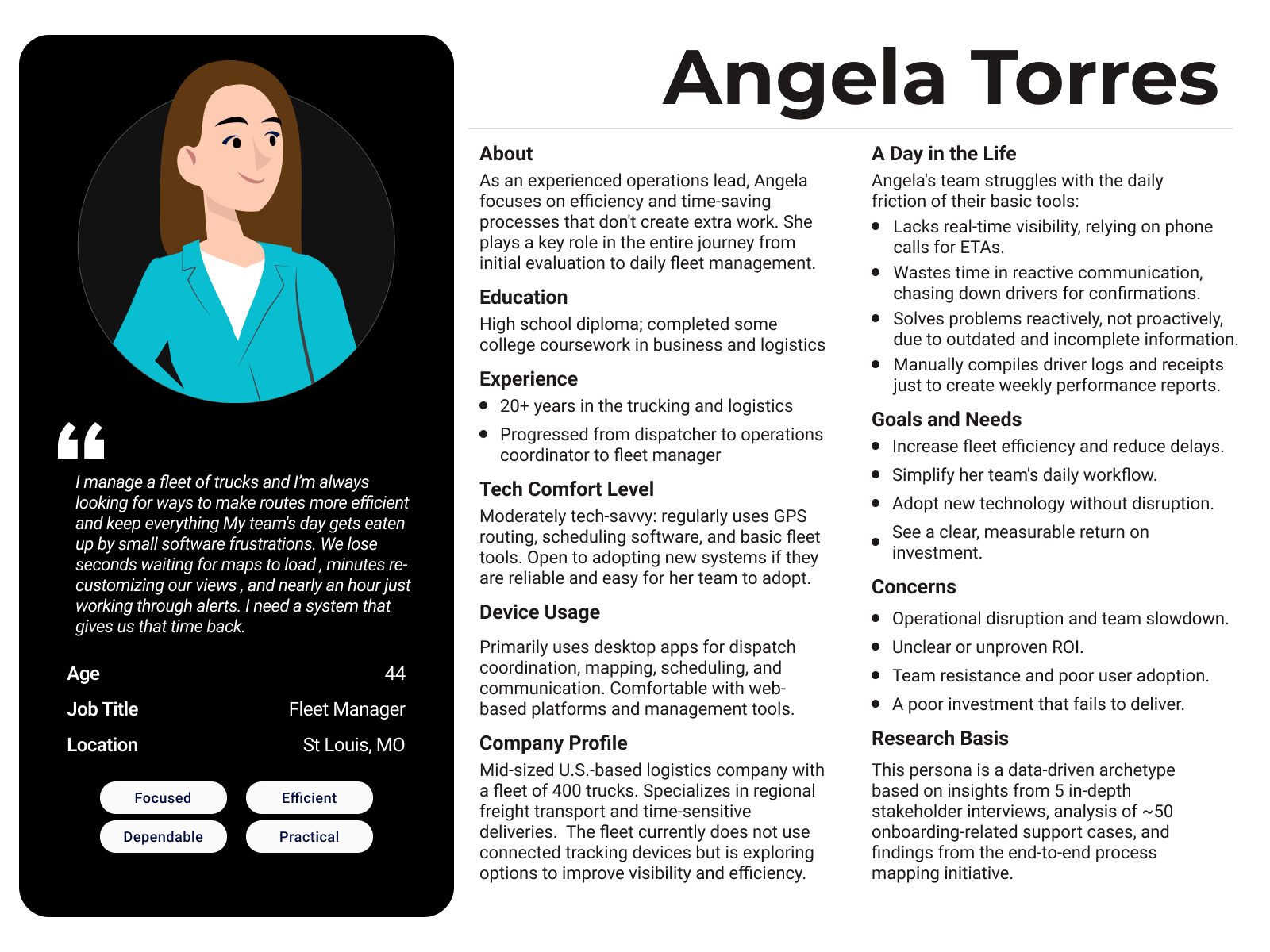
I scoped the deep-dive to "new, domestic, direct" customers -- the most common segment for which there were onboarding issues. I created the Fleet Manager persona, "Angela Torres" (Fig 1), to anchor our research in a relatable, operationally grounded use case.
-
In-Depth Stakeholder Interviews (10+ Depts)
I conducted dozens of interviews across 10+ teams, including executive leadership, Sales, Legal, Finance, and Support. The biggest challenge: every team had a different version of the process. I had to resolve these conflicts and document the unwritten steps that only existed in tribal knowledge. -
Customer Journey Mapping
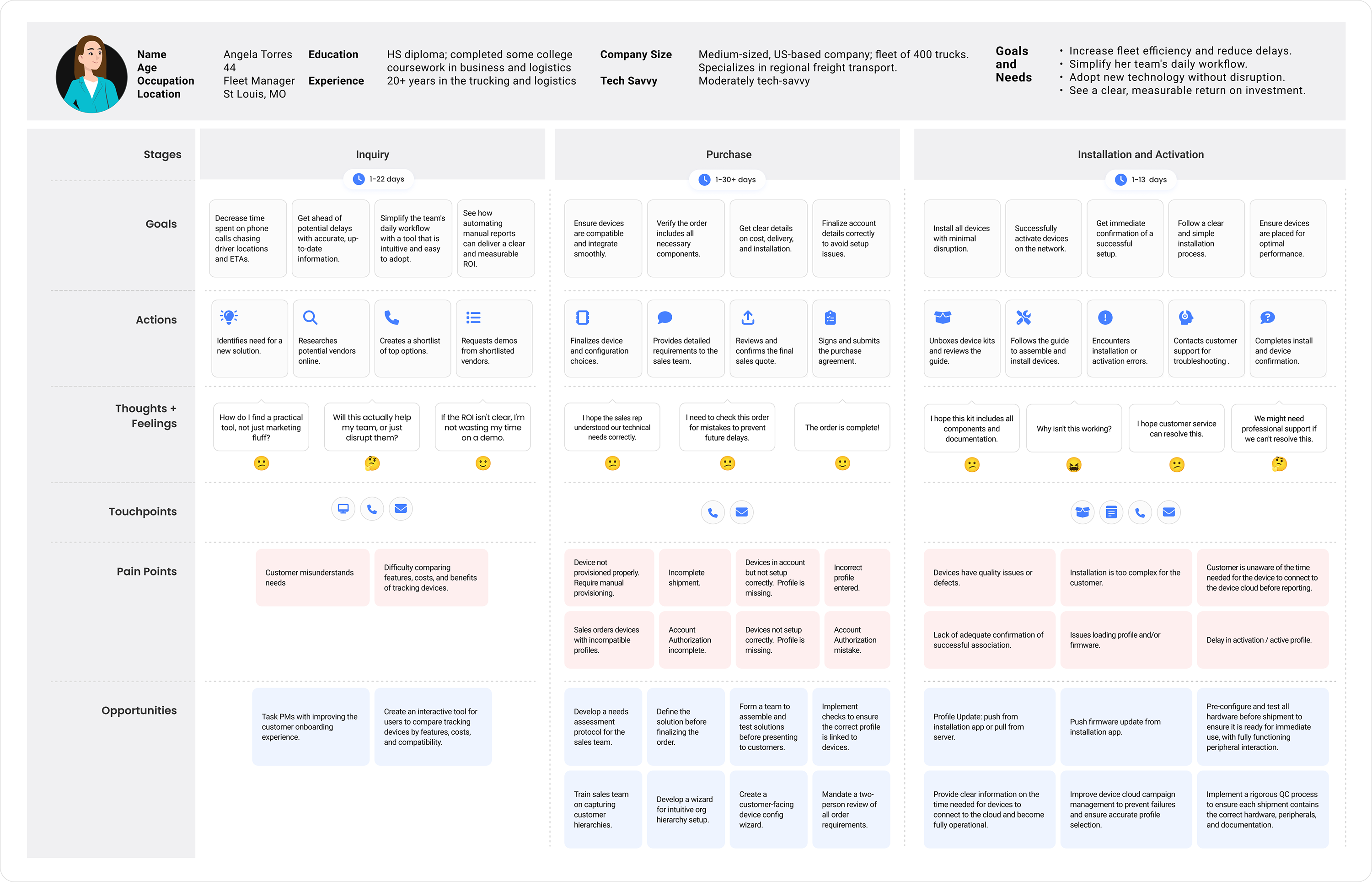
Leveraging qualitative insights from cross-functional interviews and internal support data, I created a Customer Journey Map (Fig 2) that visualized the full onboarding experience, from customer actions and thoughts to pain points and emotional drop-offs, giving teams their first outside-in view of the process.
-
First-Ever End-to-End Customer Onboarding Service Blueprint
For the first time in the company's history, I documented the entire customer onboarding process. This detailed service blueprint (5 phases, 10+ teams, nearly 80 steps) made hidden bottlenecks and costly handoff failures, like the redundant role of the "Onboarding Team", visible across the org (Fig 3). -
Quantifying the Pain Points
After surfacing recurring 'profile' issues during research, I partnered with a Customer Support data analyst to assess ticket volume. We used Excel to analyze a full year of case data and found that nearly 50% of support tickets were tied to profile-related problems, which proved the issue was systemic, not anecdotal. -
Creating a Clear Path Forward
There was no single 'aha' moment. The strategy came from connecting insights across the journey map, service blueprint, and support ticket data. This work led to a prioritized roadmap, with each recommendation tied to business impact and rationale, which I presented to executive leadership.
Key Pain Points
Pain Point
Incompatible Profile Selection
Sales often selected profiles that were incompatible with the ordered devices, leading to downstream errors and delays.
Pain Point
Flawed Profile Data and Creation
Errors during profile creation, often linked to account creation issues, resulted in misconfigured devices and high support volume.
Pain Point
Profile Application Failures
Device campaigns often failed to apply profiles correctly due to incorrect uploads, missing data, or campaigns aging out.
Uncovering the Truth: Key Discoveries and Aha! Moments
My research produced the company's first end-to-end Customer Journey Map and internal service blueprint, revealing how internal dysfunction directly caused customer pain. By combining stakeholder interviews with support log data, I surfaced several key discoveries that reshaped how the company viewed onboarding.
-
The 80/20 Revelation: Onboarding Pain Was Primarily Internal
The most pivotal finding was that ~80% of major onboarding issues came from internal processes not customer mistakes. This shifted problem-solving inward. The Customer Journey Map (Fig 2) highlighted how pain escalated in the later stages due to internal breakdowns. -
Critical Bottlenecks Quantified: Delays Measured in Weeks and Days
The "as-is" service blueprint (Fig 3) exposed 2 major chokepoints: account setups took up to 2.5 weeks, and credit checks were skipped on 99% of new orders, triggering automatic holds and 1-2 day delays on nearly every account. -
Symptomatic Redundancy: The "Onboarding Team" Workaround
Process mapping revealed that the "Onboarding Team" was a costly workaround. Their main job was fixing account setups from Sales. They added no value, but existed to patch flaws that should've been solved earlier. This became clear only after mapping the full process (Fig 3).
To make these issues tangible, I mapped a representative section of the 80-step onboarding blueprint. This slice showed how a simple Salesforce checkbox for orders under $25K could bypass unnecessary credit holds and how removing the redundant Onboarding Team loop reduced the flow from 11 steps to 6 (Fig 4).
-
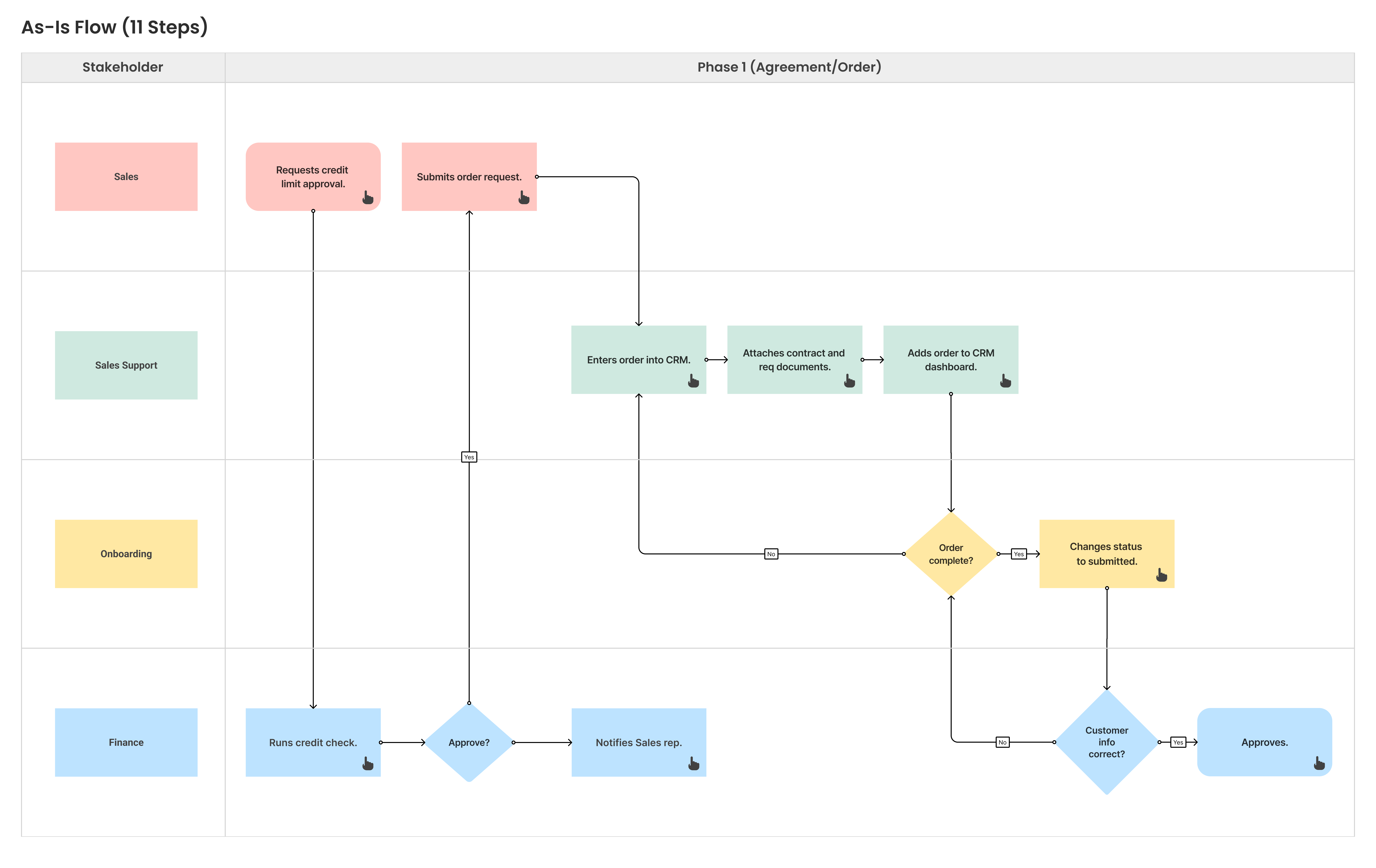
Fig 3 (Before - 11 steps) A critical section of the 'as-is' blueprint: 11 steps with a manual credit check bottleneck and an extra verification loop handled by the Onboarding Team.. -
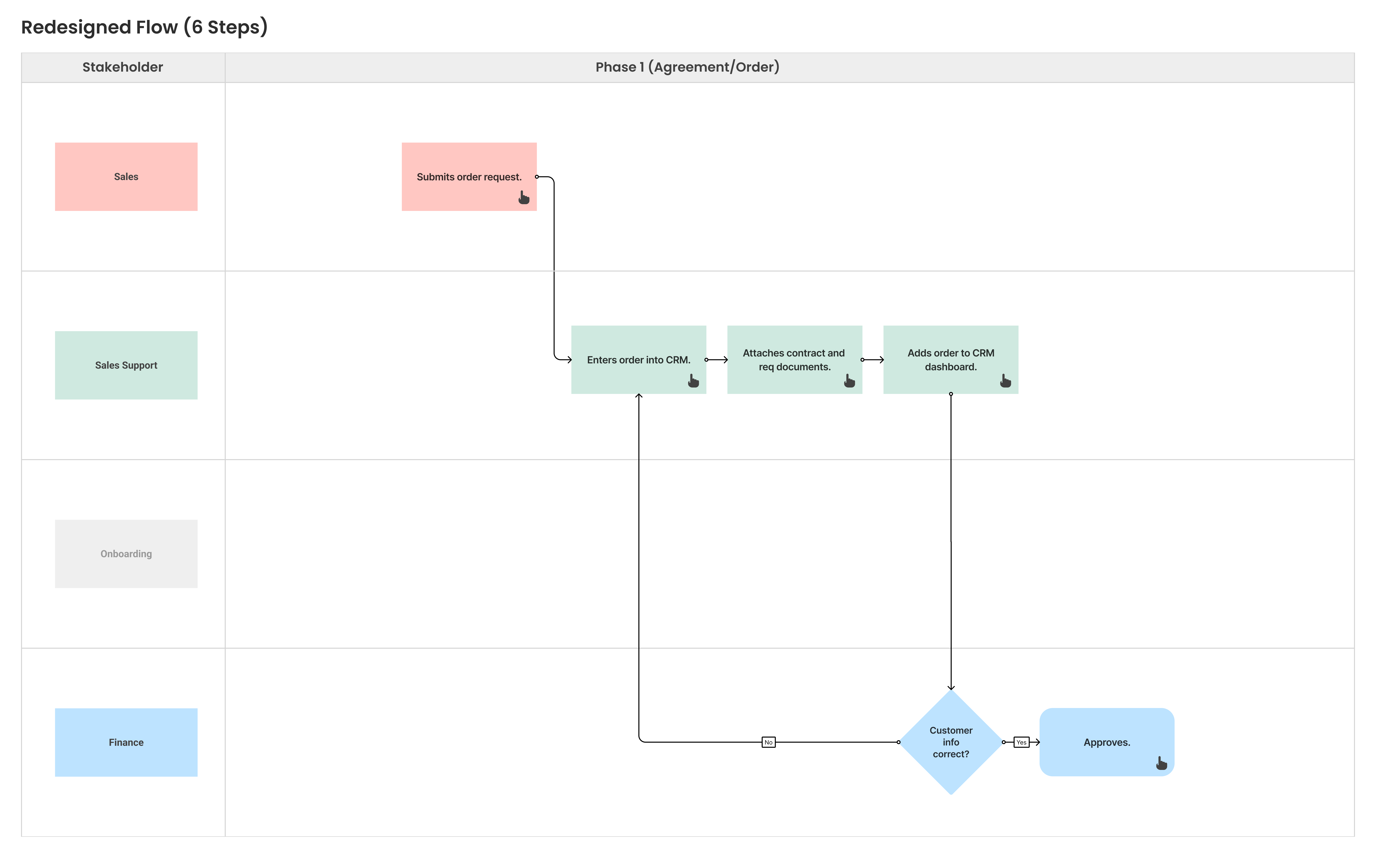
Fig. 4 (After - 6 steps)The redesigned flow: Sales can approve orders under $25K directly in Salesforce, removing the Finance delay and eliminating the Onboarding Team loop, cutting the process to 6 steps
-
Pervasive Misalignment and Knowledge Gaps
Customer-facing teams, especially Sales, often lacked up-to-date knowledge of device configurations. This caused inconsistent recommendations, missed technical requirements, and incorrect setups that failed downstream. -
The "Profile Problem" Epidemic: A Support Nightmare
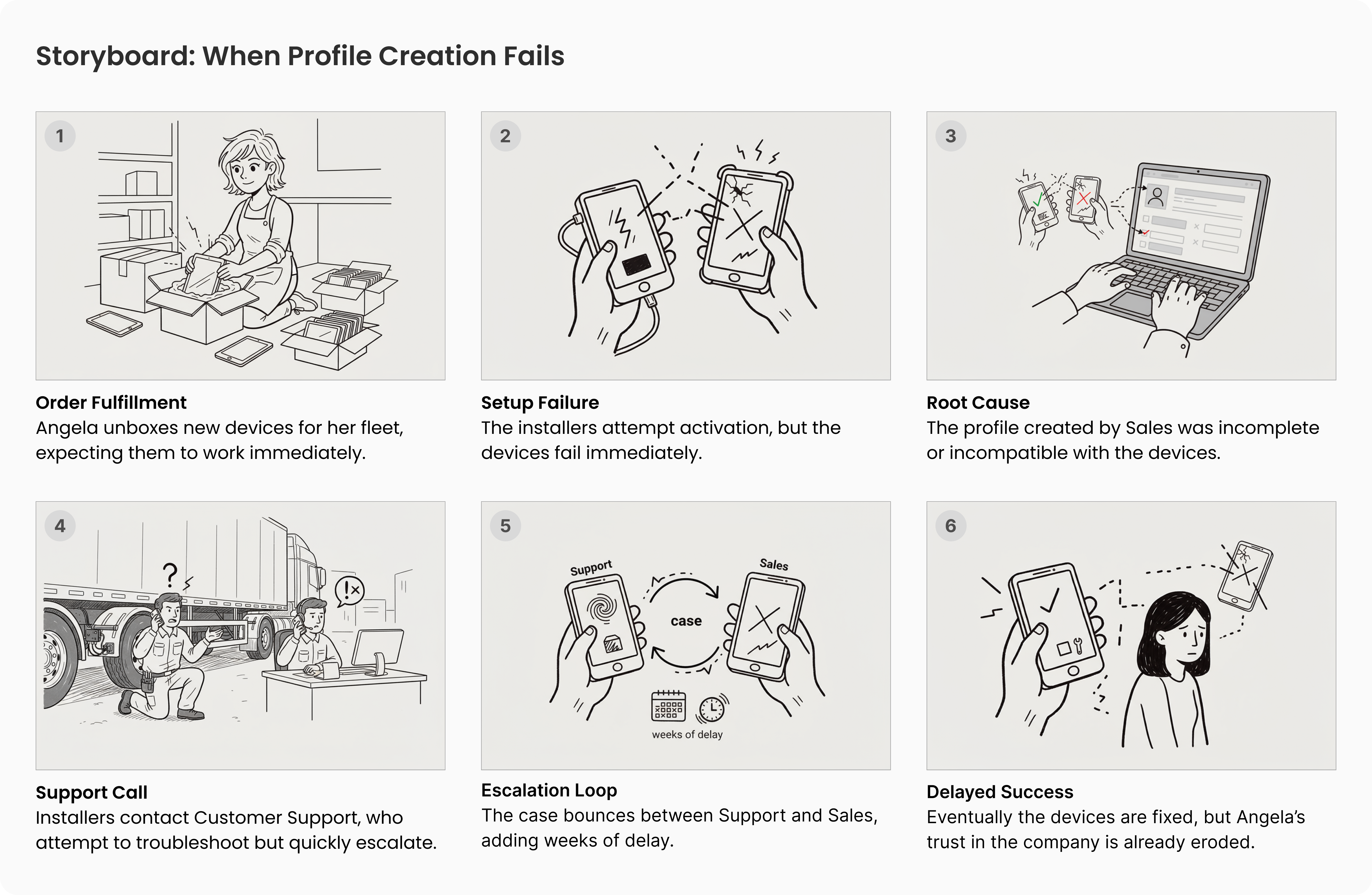
Data analysis revealed a major issue: nearly 50% of support cases (28,000+) stemmed from errors in profile creation and device configuration during setup, which was a consistent pain point across both customer and internal process maps. As illustrated in (Fig 5), even customers who followed the process correctly experienced failed activations, repeated escalations, and long delays due to these upstream profile errors.
These findings provided clear evidence that the onboarding process needed a strategic overhaul to align with business goals and customer expectations.
of total support cases were profile-related
Solutions and Recommendations
Based on my research, I developed a strategy focused on three key areas: eliminating the most damaging bottlenecks, improving data accuracy, and automating manual work. This was not a UI cleanup but a systemic overhaul, with recommendations tied to validated pain points. While several were implemented immediately, others formed the foundation for an ongoing roadmap.
Eliminating Key Bottlenecks
-
Account Setup
The Account Setup process was a major drag on onboarding. It could take up to 2.5 weeks, which was often due to missing or incorrect info, multiple handoffs, and a lack of validation checkpoints. I redesigned the workflow and surfaced required fields earlier, allowing Sales Support to complete most account setups in under a day.
Projected Impact: Cut Account Setup processing time from 2.5 weeks to ~0.5 days and eliminate redundant verification loops.
-
Credit Holds
Because credit checks weren't required, 100% of new customer orders were automatically placed on credit hold. This created a guaranteed 1-2 day shipping delay and flooded the Orders and Finance teams with manual exceptions. I proposed a policy requiring upfront credit limit assignment either automatically or through a Sales signoff-for all new accounts.
Projected Impact: Eliminate 1-2 day delays for all new customer orders and prevent thousands of support escalations tied to credit hold issues.
Improving Data Quality
-
Overhauled Profile Creation
The single biggest driver of support cases was incorrect profile creation during onboarding. I evaluated multiple paths to reduce error rates and determined that shifting responsibility from Sales to Tech Support would produce the most immediate, cost-effective impact.
Options Explored
- Option A: Train Sales (Rejected) Wouldn't prevent errors from lack of technical depth.
- Option B: Build a new tool (Rejected) Too slow + costly.
- Option C: Shift ownership to Tech Support (Chosen) Most efficient, lowest-cost fix.
Final Recommendation
Assign profile creation to the Tech Support team and require mandatory fields in Salesforce to prevent incomplete or invalid submissions.
Projected Impact: Cut profile-related support cases by ~30% (~8,588 annually) and eliminate ~12,165 onboarding delay days.
Automate Manual Work
-
Automated Profile and Campaign Creation (RPA)
Manual setup of profiles and campaigns was slow and error-prone. I recommended robotic process automation (RPA) to remove these manual steps.
Projected Impact: Reduce profile creation time by 90-95% (under 1 minute per device) and cut troubleshooting time by 90%.
Eliminating Redundancy
-
Eliminated Redundancy
My service blueprint revealed that the "Onboarding Team" existed to fix upstream errors. Their role was a costly workaround, not a value-adding function. I recommended eliminating this loop and fixing the root causes instead.
Projected Impact: Streamline the Account Setup workflow and reallocate team resources to higher-value work.
Empowering Customers and Internal Teams
Research showed that both customers and internal teams lacked the tools, structure, and visibility required to succeed.
-
Enhanced Customer Self-Service (Vision)
Proposed an online device configurator and comparison tools to help customers self-serve and reduce Sales back-and-forth by 20-40%. This would empower leaders like Angela without adding friction to their workflows. -
Equipped Sales (CSMs) for Success (Vision)
Recommended standardized forms, pre-validation checklists, and an AI Sales Chatbot to improve accuracy and reduce rework.
Future-Facing Vision: Strategic AI Integration
Looking ahead, I proposed AI to enhance customer self-service, assist CSMs, and auto-generate profiles and configurations, enabling a more adaptive, efficient onboarding experience.
Impact and Early Validation: Driving Real Business Value
Even before full implementation, early changes validated the strategy's accuracy proving the research was directionally sound and capable of driving real business value.
-
Accelerated Time-to-Revenue and Reduced Delays
The biggest gain: a faster onboarding timeline. Account Setup processing dropped from 2.5 weeks to ~0.5 days, and profile improvements were projected to eliminate ~12,165 delay days annually. Fixing credit holds was projected to cut 1-2 day delays from 100% of new customer orders highlighting a major opportunity to accelerate revenue. -
Significant Operational Efficiency and Cost Savings
Streamlined processes and automation meant real savings. Profile-related process changes were projected to cut ~8,588 support tickets annually. Tackling broader profile issues, e.g. nearly 50% of all tickets, could save 2 FTEs annually. Eliminating the Onboarding Team was an early implementation win that reinforced the overall strategy's efficiency projections. -
Enhanced Customer and Team Experience
A smoother, more accurate onboarding experience would improve customer trust and reduce churn risk. Internally, fewer fire drills and less manual rework meant higher morale and more productive teams.
Conclusion, Lessons and Future Vision
Successfully leading this initiative from a vague problem to actionable, data-backed solutions required strategic thinking, persistence, and strong cross-functional leadership.
My Leadership in Action
-
Strategic Vision and Problem Reframing
I reframed the scope from "Device Provisioning" to "Customer Onboarding," enabling systemic solutions and securing executive buy-in. -
Pioneering Process Discovery
In a fully undocumented environment, I mapped the entire journey and nearly 80-step onboarding process across 10+ departments, using BPR to expose critical flaws. -
Championing Data-Driven Decisions
I collaborated with analysts to quantify key findings, e.g., 50% of support tickets were profile-related, giving leadership hard proof for action. -
Driving Cross-Functional Alignment
I aligned 10+ departments through dozens of interviews, resolving conflicting narratives and presenting a unified strategy to the CTO.
Key Challenges Overcome
-
Navigating Extreme Complexity and Ambiguity
With no existing documentation, I pieced together the entire 80-step workflow through iterative interviews and validation. -
Eliciting "Tribal Knowledge"
I surfaced and reconciled tribal knowledge across teams to build the first accurate "as-is" onboarding service blueprint.
Core Lessons Learned
-
Holistic Mapping Unlocks Systemic Insights
Mapping the full journey and internal processes is essential for exposing buried organizational issues. -
Qualitative + Quantitative Data = Undeniable Impact
Combining qualitative research with hard data creates a case for change no one can ignore. -
Strategic UX Drives Business Value
Leadership recognized how UX-led process analysis drove measurable business results, reinforcing the value of strategic UX.
This initiative deepened my expertise in enterprise UX strategy, process optimization, and user-centered business transformation.
Overall Conclusion and Looking Ahead
This initiative transformed onboarding from a fragmented technical task into a holistic, UX-led strategy that addressed the root causes of delay, cost, and churn. The primary deliverable of this initiative was a foundational, research-driven roadmap that transformed onboarding from a fragmented task into a holistic, scalable strategy.
While progress was significant, this foundation sets the stage for AI-driven improvements, smarter workflows, and a scalable model for customer-centric onboarding.